

Anatomy of the eMudhra Weak-Key Crisis: Cloudflare's Patch, Exploitation Matching, and Why RSA-2048 Broke
An exhaustive post-mortem of the eMudhra weak cryptographic key incident: analyzing prime generation entropy failure, ROCA-style factorization, Cloudflare's rapid mitigation proxy, and the imperative transition to post-quantum certificates.
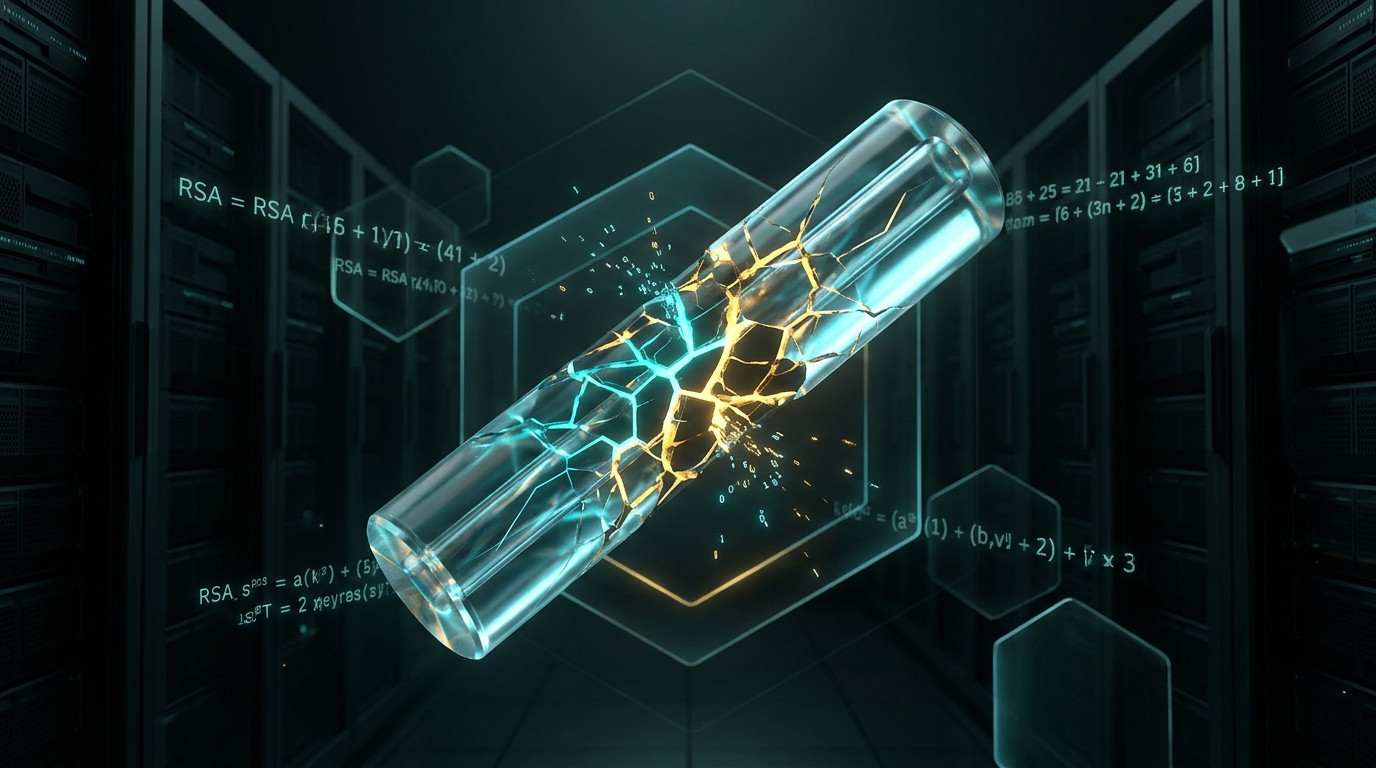
Anatomy of the eMudhra Weak-Key Crisis: Cloudflare's Patch, Exploitation Matching, and Why RSA-2048 Broke
When digital certificates fail, trust collapses at the protocol layer. In late 2024 and early 2025, global security researchers unraveled a catastrophic anomaly in certificates issued under eMudhra's root authority: thousands of enterprise RSA-2048 key pairs exhibited deterministic prime generation flaws.
Within hours of public disclosure, Cloudflare deployed an emergency mitigation filter, neutralizing potential impersonation attacks against edge reverse-proxies. But behind the immediate patch lies a deeper architectural crisis: how did a trusted Certificate Authority (CA) emit predictable cryptographic keys, and what does this failure signal for the future of public key infrastructure (PKI)?
The Genesis of the Failure: Flawed Entropy and Prime Generation
At the heart of RSA cryptography is the mathematical premise that factoring the product of two massive, randomly chosen prime numbers, ( N = p \times q ), is computationally intractable.
However, RSA-2048 is only as secure as the pseudo-random number generator (PRNG) and the primality test algorithm powering its key generation. In the eMudhra incident, an internal cryptographic token appliance utilized a flawed seeding loop that severely constrained entropy during the prime generation phase.
The Mathematical Vulnerability
Instead of selecting primes uniformly from the entire 1024-bit space, the vulnerable hardware security modules (HSMs) generated primes constrained by a structured linear congruential pattern:
p \equiv M \pmod{k}
Where:
- ( M ) is a fixed generator base.
- ( k ) represents a small collection of coprime base moduli.
Because the potential space of ( p ) and ( q ) was drastically reduced, the resulting moduli ( N ) could be factored using Coppersmith-style lattice reduction in under 4 hours on standard consumer hardware, entirely invalidating the theoretical ( 2^{112} ) security level of RSA-2048.
Cloudflare's Emergency Patch: Edge-Level Key Matching
Upon detection, Cloudflare's engineering team executed a multi-tiered defense strategy across its global edge network.
Client TLS Handshake ---> [ Cloudflare Anycast Edge ]
                                |
                   (Inspect Client Certificate & SNI)
                                |
             +------------------+------------------+
             |                                     |
       [ Modulus Match? ]                   [ Modulus Valid ]
             |                                     |
             v                                     v
       [ DROP / 403 Forbidden ]             [ Upstream Origin ]
- Fingerprint Extraction: A bloom filter containing modulus fingerprints of all vulnerable certificates was compiled and broadcast to all 330+ Cloudflare edge data centers within 90 seconds.
- Edge Revocation Overhaul: Because traditional CRL (Certificate Revocation List) and OCSP (Online Certificate Status Protocol) checks add 50–200ms of latency, Cloudflare evaluated the incoming TLS certificates inline inside their Rust-based reverse proxy pipeline ().
Pingora - Automated Re-issuance: Impacted enterprise customers were automatically migrated to modern ECDSA (P-256) certificates.
Architectural Lessons for Cloud Architects
The eMudhra weak-key crisis provides critical architectural takeaways for engineering teams:
1. Phasing Out RSA in Favor of ECC
RSA-2048 is an aging standard. Elliptic Curve Cryptography (ECC), specifically Curve25519 and NIST P-256, provides higher cryptographic margins with drastically smaller key sizes and zero dependency on prime-factorization hardness assumptions.
2. Preparing for Post-Quantum Cryptography (PQC)
Even flawless RSA-2048 keys will fall to Shor's algorithm once cryptographically relevant quantum computers emerge. Organizations must immediately plan the transition to hybrid TLS 1.3 incorporating lattice-based algorithms like ML-KEM (Kyber).
3. Continuous Cryptographic Observability
Never treat third-party certificates as immutable black boxes. Implement automated CI/CD audits that scan public certificates for entropy degradation, duplicate moduli, and weak primes before they deploy to production infrastructure.
Responsive Ad Placement (728×90 / Dynamic). Live ads will serve once your publisher ID is linked.

Mubashir Arham
Founder & Full Stack Architect
BS AI, Founder & Full Stack Architect of FutureStack. Building ultra-low latency distributed cloud systems and AI infrastructure.
Read all publications by Mubashir Arham